Adventure Consultants
The ClimbAdventure Consultants was the New Zealand guiding company led by Rob Hall, whose commercial record and disciplined expedition structure made it a major presence on Everest. In 1996 it returned after a season in which Hall had turned all his clients around, and its summit attempt became entangled with the Mountain Madness expedition, the uncompleted preparation of fixed ropes, and the catastrophe of May 10–11. The company’s story joins commercial ambition to the fragile systems of safety and communication on which clients depended high on the mountain.
Company and Commercial Ambition
Adventure Consultants was among the commercial expeditions that brought paying clients to Everest Base Camp. Since the company began taking expeditions to Everest in 1990, Hall had guided a combined thirty-nine clients and expedition personnel to the summit, a record that helped make the company’s advertising persuasive. An early 1995 advertisement proclaimed “100% Success! Send for Our Free Color Brochure.” That claim ended in May 1995, when deep snow slowed the team and Hall turned all his clients back without a summit.
Hall returned in 1996 under pressure to restore the company’s winning record. Summit success, rather than a safe turnaround, was what attracted new business. The commercial stakes were visible in the expedition’s dealings with Outside: the magazine ultimately bought Jon Krakauer’s place from Adventure Consultants after negotiations with Mountain Madness failed. Outside said it had considered not only price but also Hall’s greater experience guiding on Everest, his safety record, and Krakauer’s assessment of the company’s oxygen system. The transaction brought a journalist-climber into Hall’s team and sharpened the rivalry with Scott Fischer’s Mountain Madness.
Expedition Structure and Route Preparation
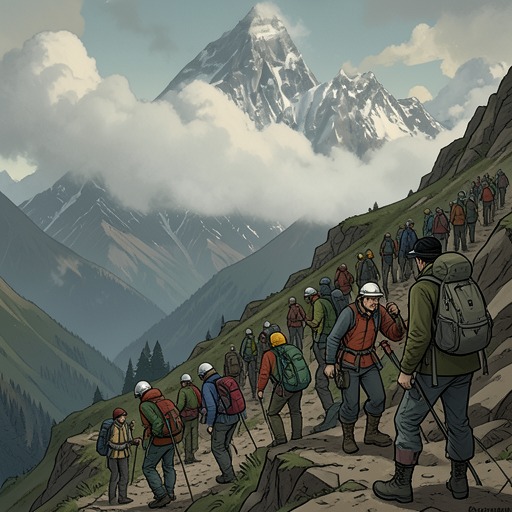
Hall’s expedition flew from Kathmandu to Lukla to begin its trek toward Everest Base Camp. On summit night the company took fifteen people onto the mountain: Hall, two other guides, eight clients, and four Sherpas, including climbing sirdar Ang Dorje Sherpa. The team left Camp IV thirty minutes ahead of Mountain Madness. Its headlamps formed a chain on the route, but the two expeditions soon caught and passed one another; by about 4:00 A.M. their climbers were thoroughly intermingled with one another and with members of the Taiwanese National Expedition.
The two commercial teams had agreed with other expeditions to cooperate in fixing ropes between Camps III and IV. Mountain Madness sent Sherpas to the shared work rather than its guides, and the expedition leaders sought to secure an early place for their summit attempt. Higher up, the climbers expected the ropes between Camp IV and the summit to be fixed before they set out from camp. Accounts from clients on both teams describe that expectation: the climbing sirdars, Ang Dorje and Lopsang Jangbu Sherpa, were supposed to leave ahead of the clients so that the climbing groups would not have to wait.
That preparation had not taken place as expected. Neither Ang Dorje nor Lopsang, nor any other Sherpas, had left Camp IV early to fix the upper ropes. Lopsang later said that a member of the 1996 Montenegrin expedition had told him the ropes were already fixed. Jon Krakauer disputed that explanation, noting that both sirdars had left with rope in their packs. The account leaves uncertainty over what each leader knew and when; it does establish that the clients reached a route whose promised preparation was absent, adding delays and exposure in the high-altitude Death Zone.
Summit-Day Rules and Client Dependence
Hall’s approach to control on the mountain was more rule-bound than Fischer’s situational strategy. During the first half of summit day, Hall instructed his climbers not to move more than one hundred meters apart until they reached the Balcony. Krakauer, used to making independent decisions, recalled feeling that his position as a client had forced him to surrender that independence and act like a “tin soldier.” The spacing rule expressed a guiding system in which individual freedom was subordinated to group management, but it also meant that climbers could be held to the pace and needs of the slowest members.
The team’s turnaround instructions were less clear. Hall’s clients understood different deadlines: some recalled one o’clock, others two, and some thought the decision would be made on the mountain. This ambiguity contrasted with the public description of Fischer’s Two O’Clock Rule, although Fischer himself had not set a definite summit-day cutoff for his clients either. Hall’s team therefore faced not only the physical hazard of the route but uncertainty over when the guide would call an end to the attempt.
The oxygen plan made that uncertainty consequential. Hall and Fischer had planned for each client to receive three canisters, intended to last through a return to Camp IV by 6:00 P.M. Hall’s guides and Sherpas were also meant to have oxygen cached higher on the route. Yet the amount remaining at the South Summit became disputed. Krakauer later wrote that at least six bottles remained when he and others arrived there; Mike Groom recalled distributing full bottles to several climbers and taking one himself, while two Sherpas also took bottles. The accounts do not reconcile, and Krakauer’s published account further states that Hall reached the South Summit with two full canisters. The uncertainty matters because the team’s survival on descent depended on oxygen being available when the schedule slipped.
Storm, Rescue, and Losses
On the descent, Groom gave his oxygen canister to Krakauer, who had exhausted his own supply and was in distress. With that help, Krakauer reached the South Summit, took a fresh bottle from the cache, and continued down. Hall’s two guides, Andy Harris and Groom, were on either side of him; he was ultimately the only Adventure Consultants client who both summited and survived. Doug Hansen and Yasuko Namba died during the descent.
By the morning of May 11, the expedition was in crisis. Hall remained immobile at the South Summit and was freezing. Hansen, last known to have been with him the previous evening, was presumed dead; Harris had not returned to his tent. Hall’s team members found Beck Weathers and Namba near the Kangshung Face, where Boukreev had earlier found other climbers. Krakauer, Groom, John Taske, and Stuart Hutchison discussed what to do and decided to leave Weathers and Namba where they lay, believing rescue was impossible. Both were later found to have signs of life.
Two of Hall’s Sherpas attempted to climb toward him and any other survivors but turned back in worsening weather without finding them. At 6:20 P.M., Hall reached Base Camp by radio and was patched through to his wife in New Zealand. He sent his love, told her not to worry, and signed off. Those were the last words heard from him. The company’s expedition ended not with a return to its commercial success but with the death of its leader and two clients, and with unresolved questions about preparation, oxygen, and the decisions made on the mountain.
Significance and Aftermath
Adventure Consultants embodies the tension between selling a guided summit attempt and managing a climb whose hazards cannot be made routine. Hall’s record, advertising, and return after the 1995 turnaround placed pressure on the 1996 expedition, while its clients depended on decisions about spacing, turnaround limits, ropes, and oxygen. The gap between what climbers expected—fixed ropes laid before their departure—and what they encountered shows how a plan can fail at the point where several teams share work but no single account fully establishes who knew that it had not been done.
The tragedy also exposed the limits of interpreting responsibility through one person’s conduct. The company’s clients were not simply independent climbers: they were paying customers moving within a guided structure, with rules and resources intended to support them. Yet the storm and depleted supplies forced immediate choices by guides and clients alike. The surviving record preserves conflicting recollections, especially about oxygen at the South Summit, while confirming the human consequence: Groom’s canister helped Krakauer descend, but Hall, Hansen, and Namba did not return.